Most aspiring commercial pilots underestimate the impact that a structured preflight briefing checklist can have on both their exam scores and their future safety culture. For Central European trainees working toward EASA certification, every detail counts—especially with the high standards set by British and wider European authorities. By following a thorough, step-by-step approach, you gain confidence, minimise stress, and build habits that top airlines expect. Discover the proven strategies trusted by experienced British pilots for seamless exam preparation and airworthiness.
Table of Contents
- Step 1: Gather Essential Documents And Briefing Materials
- Step 2: Review Weather And Notams For Operational Awareness
- Step 3: Assess Aircraft Status And Confirm Load Calculations
- Step 4: Verify Crew And Passenger Information Accuracy
- Step 5: Conduct Safety And Emergency Procedure Briefing
- Step 6: Complete Final Verification Of All Checklist Items
Quick Summary
| Key Point | Explanation |
|---|---|
| 1. Assemble all necessary documents | Essential documents include pilot licence, medical certificate, passport, aircraft registration, and airworthiness certificate for operational readiness. |
| 2. Conduct thorough weather and NOTAM checks | Review METAR and TAF reports alongside NOTAMs to understand weather impacts and operational restrictions affecting your flight. |
| 3. Perform detailed aircraft inspection | Ensure the aircraft is mechanically sound and loaded correctly by checking maintenance logs, weight calculations, and confirming safety limits are within specifications. |
| 4. Verify crew and passenger credentials | Review and confirm the accuracy and validity of crew and passenger documents to ensure compliance with regulatory requirements for the flight. |
| 5. Execute final checklist verification | Conduct a comprehensive review of all documentation and perform a walk-around inspection to ensure every critical operating aspect is addressed before flight. |
Step 1: Gather essential documents and briefing materials
As a pilot preparing for flight, securing all necessary documentation is your first critical task. Thorough preflight documentation ensures compliance, safety, and operational readiness across European airspace.
Start by assembling your core documentation package. This includes your personal pilot licence, medical certificate, current passport, aircraft registration documents, and airworthiness certificates. Organise your navigation charts, route planning materials, and current aeronautical information publications. Ensure all documents are current, signed, and easily accessible in a waterproof document holder or flight bag.
Remember that each document serves a specific purpose in demonstrating your preparedness and legal authorisation to operate an aircraft. Double check expiration dates, validate any recent endorsements, and confirm that your documentation matches the specific aircraft type and operational requirements for your planned flight.
Top Tip: Create a digital backup of all critical documents and store encrypted copies in secure cloud storage as an additional precautionary measure.
Here is a summary of essential document types and their unique roles for flight operations:
| Document Type | Primary Purpose | Regulatory Focus |
|---|---|---|
| Pilot Licence | Legal pilot authorisation | Certification |
| Medical Certificate | Confirms pilot fitness | Health regulations |
| Passport | International identity verification | Border compliance |
| Aircraft Registration | Proves aircraft legal ownership | Aviation authority record |
| Airworthiness Certificate | Ensures aircraft meets safety standards | Operational safety |
| Navigation Charts | Route and airspace information | Navigational planning |
| Aeronautical Publications | Updated flight restrictions & guidance | Information accuracy |
Step 2: Review weather and NOTAMs for operational awareness
Preparing for a safe flight requires comprehensive weather analysis and understanding current operational notices. Aviation weather information plays a critical role in flight planning, helping pilots make informed decisions about route safety and potential challenges.
Begin by accessing comprehensive weather briefing resources that provide detailed meteorological insights. Review METAR and TAF reports for your departure, destination, and alternate airports, paying close attention to visibility, wind conditions, precipitation, and potential thunderstorm developments. Consolidated European aviation data can help you understand complex weather patterns across your entire flight route. Simultaneously, examine current NOTAMs for any operational restrictions, temporary flight limitations, navigational hazard warnings, or airspace modifications that might impact your planned journey.
Carefully cross reference multiple weather sources to validate information and identify any potential discrepancies. Analyse wind speeds at different altitudes, temperature variations, and potential icing conditions that could affect aircraft performance. Remember that weather interpretation is not just about reading data but understanding its implications for your specific flight parameters.
Top Tip: Always download and screenshot your weather briefing and NOTAM reports as a permanent record for your flight documentation.
The following table compares the focus areas of weather and NOTAM checks in pre-flight preparation:
| Focus Area | Key Considerations | Impact on Flight Planning |
|---|---|---|
| Weather Briefing | Visibility, wind, precipitation | Determines route and safety choices |
| NOTAM Review | Operational restrictions, hazards | Highlights limitations and warnings |
| Data Validation | Cross-reference multiple sources | Ensures information reliability |
Step 3: Assess aircraft status and confirm load calculations
Ensuring your aircraft is mechanically sound and properly loaded is fundamental to safe flight operations. Aircraft load and trim procedures demand meticulous attention to detail and systematic verification of multiple critical parameters.
Begin with a comprehensive pre-flight technical inspection of the aircraft. Review the maintenance logs to confirm all scheduled inspections and required maintenance have been completed. Examine the aircraft exterior for any signs of damage, checking critical components such as control surfaces, tyres, engine condition, and potential fluid leaks. Load control documentation requires precise calculation of passenger weight, cargo distribution, and fuel quantity to ensure the aircraft remains within its centre of gravity limits.
Calculate your total aircraft weight by systematically adding passenger weights, cargo, equipment, and fuel. Cross reference these calculations with the manufacturer’s specific loading charts, paying particular attention to weight distribution across different aircraft compartments. Verify that your total calculated weight does not exceed the maximum takeoff weight specified in the aircraft flight manual. Remember that accurate load calculations are not just a regulatory requirement but a critical safety measure that directly impacts aircraft performance and stability.

Top Tip: Always perform your weight and balance calculations twice and have a second pilot or qualified crew member independently verify your computations.
Step 4: Verify crew and passenger information accuracy
Accurate passenger and crew documentation forms the cornerstone of safe and compliant flight operations. Passenger information systems require meticulous verification to meet international security and regulatory standards.
Begin by systematically reviewing each crew member and passenger’s documentation. Check passports for validity, ensuring they meet the minimum six month expiration requirement for international travel. Verify that all travel documents are authentic, match passenger names exactly, and include necessary visas or entry permissions. European border control protocols mandate comprehensive cross referencing of passenger name records with official databases to confirm identities and detect potential security risks.
Pay special attention to discrepancies in personal information across different documents. Confirm that passenger manifests are complete, with accurate spellings, birthdates, nationalities, and emergency contact details. Cross check passenger lists against your flight manifest, ensuring no last minute changes have created potential documentation gaps. Validate crew certifications, medical clearances, and current licensing status as part of your comprehensive pre flight information verification process.
Top Tip: Create a standardised digital checklist for document verification to ensure no critical details are overlooked during the pre flight information review.
Step 5: Conduct safety and emergency procedure briefing
Communicating critical safety protocols is fundamental to ensuring passenger protection and crew readiness. Pre-flight safety checklists provide structured guidance for comprehensive emergency preparedness.
Deliver your safety briefing with clear, concise language that ensures all passengers understand essential procedures. Demonstrate the proper use of safety equipment including life jackets, oxygen masks, emergency exits, and seat belt mechanisms. Walk through specific evacuation protocols, highlighting the nearest emergency exits and explaining the brace position for potential impact scenarios. Crew resource management strategies emphasise the importance of creating a shared understanding of emergency response protocols among all crew members and passengers.
Ensure your briefing covers key scenarios such as emergency landings, cabin depressurisation, fire management, and communication breakdown. Use visual demonstrations where possible, and encourage passengers to ask questions for clarification. Verify that passengers with special needs or mobility challenges understand specific evacuation instructions tailored to their requirements.
Top Tip: Practice your safety briefing delivery to maintain a calm, authoritative tone that simultaneously informs and reassures passengers about emergency preparedness.
Step 6: Complete final verification of all checklist items
The final pre-flight verification represents your last opportunity to ensure comprehensive operational readiness and safety compliance. Pre-flight inspection protocols demand systematic and methodical review of every critical component and documentation requirement.
Systematically work through your final verification checklist, treating each item as absolutely crucial. Begin by meticulously reviewing all previously prepared documentation including flight logs, maintenance records, passenger manifests, and navigation charts. Digital pre-flight checklists can help standardise and streamline this process, ensuring no critical detail is overlooked. Cross reference your physical documents with digital records, confirming absolute consistency and identifying any potential discrepancies that might compromise flight safety.
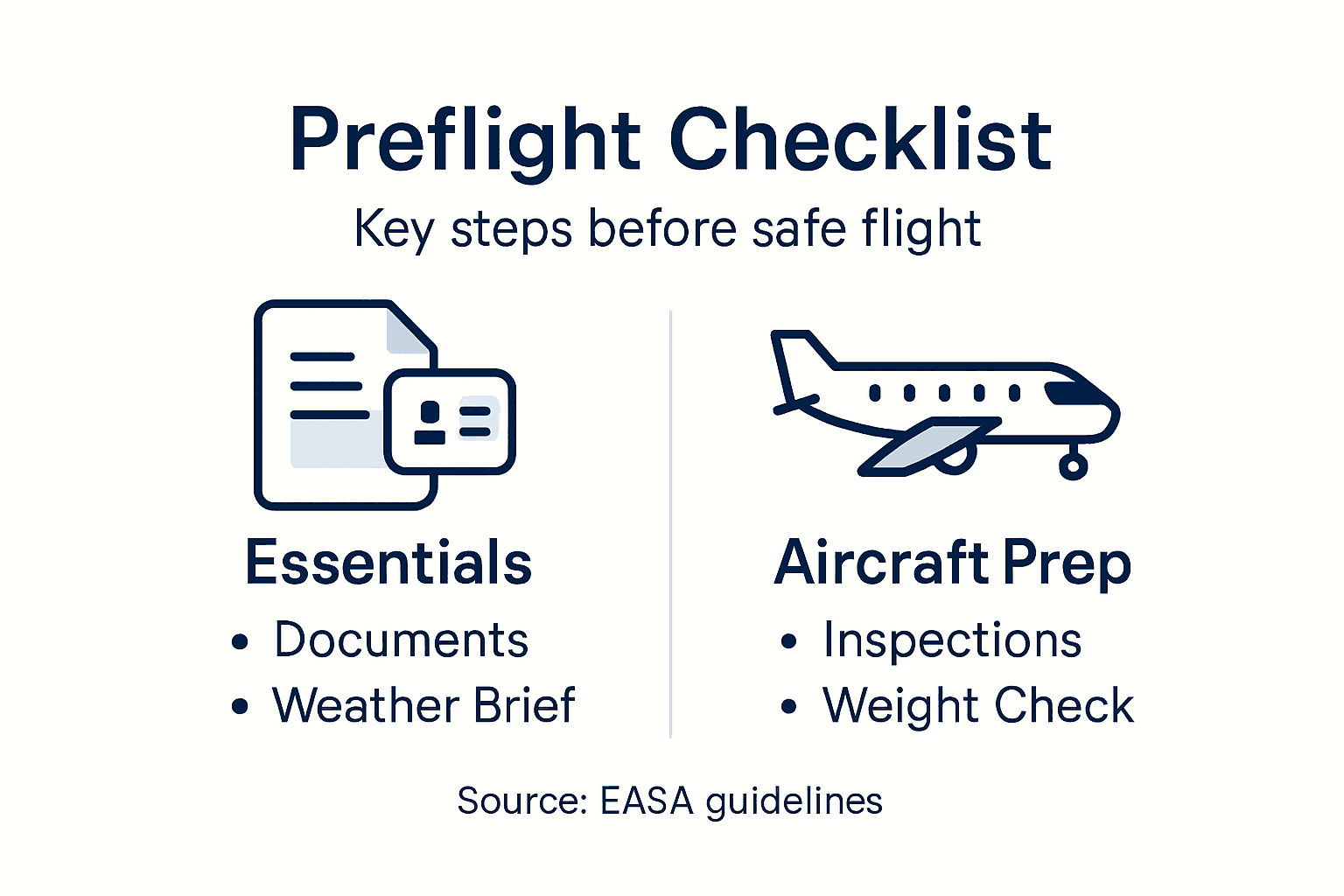
Perform a comprehensive walk around inspection of the aircraft, physically verifying external conditions such as control surface integrity, tyre pressure, fuel levels, and absence of any visible damage or anomalies. Confirm that all required emergency equipment is present, accessible, and within current certification dates. Validate that communication systems are fully functional and that all crew members understand their specific roles and responsibilities for the upcoming flight.
Top Tip: Develop a personal pre-flight verification rhythm where you consistently follow the same methodical sequence to minimise the risk of human error.
Elevate Your Preflight Preparation with Expert Online Pilot Training
The challenge of mastering a thorough preflight briefing checklist calls for deep understanding of critical procedures such as document verification, weather analysis, aircraft load calculations and safety briefings. Many aspiring pilots find it difficult to confidently process these complex requirements while ensuring full regulatory compliance and operational safety. At VictorOne.eu, we understand that your goal is to not only memorise but fully comprehend these essential aviation concepts so you can operate with assurance and professionalism.

Take control of your pilot training journey now with comprehensive, EASA-approved online theoretical courses designed specifically for aspiring commercial pilots. Whether you want to sharpen your knowledge of preflight checklists, aviation weather interpretation or crew resource management, our flexible digital learning platform offers high-quality resources and interactive support wherever you are in the world. Start preparing for your licensing exams, enhance your understanding of operational protocols and build the confidence you need to perform flawless preflight procedures. Explore more about our course offerings and exam support at VictorOne.eu and begin the next important step towards safe and successful pilot operations today.
Frequently Asked Questions
What documents do I need to prepare for my flight?
To ensure safe pilot operations, you must gather essential documents such as your personal pilot licence, medical certificate, passport, aircraft registration documents, and airworthiness certificates. Organise these in a waterproof holder and verify their expiration dates prior to your flight.
How can I ensure that I am informed about current weather conditions before flying?
Access detailed weather briefing resources, including METAR and TAF reports, for your departure, destination, and alternate airports. Analyse visibility, wind, precipitation, and any significant weather developments to make informed decisions about your flight.
What steps should I follow to assess my aircraft’s status before take-off?
Start by conducting a thorough pre-flight technical inspection, including reviewing maintenance logs and checking critical components like control surfaces and tyres. Confirm that your load and balance calculations align with the aircraft’s specifications to ensure it is within safe operational limits.
How do I verify that my passengers and crew have the correct documentation?
Systematically review the documentation of each crew member and passenger, focusing on passport validity and necessary visas. Ensure that all details match exactly with the flight manifest to avoid discrepancies that could hinder your flight operations.
What key topics should be covered in a safety and emergency procedure briefing?
Your safety briefing must include the proper use of safety equipment, evacuation protocols, and emergency response procedures. Engage passengers by demonstrating equipment usage and encouraging them to ask questions for clarity regarding emergency situations.
How can I ensure I have completed all necessary checks before my flight?
Work methodically through a final verification checklist that includes confirming documentation, conducting a walk-around inspection, and ensuring communication systems are functional. This prevents potential oversight and solidifies your readiness for a safe flight.