Even a slight miscalculation in aircraft performance can mean the difference between a safe landing and a critical emergency. For every takeoff, climb, and landing, pilots depend on precise performance calculations backed by tough regulatory standards. These complex evaluations shape every stage of a flight, affecting safety, efficiency, and operational decisions. Understanding how these calculations work helps pilots, engineers, and aviation enthusiasts grasp what keeps modern air travel safe and reliable.
Table of Contents
- Aircraft Performance Calculations Defined and Explained
- Essential Types of Performance Calculations
- Key Factors Affecting Calculation Accuracy
- EASA Regulations on Performance Calculations
- Common Errors and Safety Implications
- Practical Uses in Pilot Training and Operations
Key Takeaways
| Point | Details |
|---|---|
| Operational Importance | Aircraft performance calculations are crucial for safety and efficiency during flight operations, influencing critical decisions in pre-flight planning and in-flight scenarios. |
| Regulatory Framework | EASA regulations mandate strict methodologies for performance calculations, ensuring compliance with safety and operational standards. |
| Accuracy Factors | Accurate calculations depend on environmental conditions and aircraft-specific variables, necessitating thorough validation against established data sources. |
| Error Prevention | Continuous training in performance calculations is essential to mitigate errors that could lead to serious safety consequences, emphasizing a culture of precision and systematic verification. |
Aircraft Performance Calculations Defined and Explained
Aircraft performance calculations are systematic mathematical evaluations that determine an aircraft’s operational capabilities, efficiency, and safety across various flight conditions. According to the EASA Easy Access Rules for Aircrew, these calculations encompass critical parameters that directly impact flight planning and operational decision-making.
Performance calculations integrate multiple complex variables including aircraft weight, atmospheric conditions, runway characteristics, and aerodynamic properties. Pilots and flight engineers use these precise mathematical models to assess:
- Takeoff and landing distances
- Fuel consumption rates
- Climb and descent performance
- Maximum achievable speeds
- Range and endurance limitations
- Load-carrying capabilities
The comprehensive framework established by EASA mandates rigorous calculation protocols that ensure aircraft operate within safe and prescribed performance envelopes. These calculations are not merely theoretical exercises but fundamental safety mechanisms that prevent potential operational risks during different flight phases.
Understanding aircraft performance calculations requires mastering specialized charts, computational techniques, and a deep comprehension of aerodynamic principles. Pilots must account for dynamic variables such as temperature, altitude, wind conditions, and aircraft configuration to generate accurate performance predictions. While technology has simplified many computational processes, the core skill remains a critical component of professional aviation training, demanding precision, analytical thinking, and comprehensive technical knowledge.
Essential Types of Performance Calculations
Pilots and flight engineers rely on various critical performance calculation types that ensure safe and efficient aircraft operations across different flight phases. According to EASA Air Operations regulations, these calculations cover a comprehensive range of operational parameters essential for flight planning and safety.
The primary performance calculation categories include:
- Takeoff Performance Calculations
- Accelerate-stop distance assessment
- Takeoff field length requirements
- Climb gradient determinations
- Obstacle clearance evaluations
- Landing Performance Calculations
- Landing distance requirements
- Runway surface condition analyses
- Brake energy calculations
- Approach and touchdown performance metrics
- En-Route Performance Calculations
- Cruise performance parameters
- Fuel consumption projections
- One-engine inoperative performance scenarios
- Wind and altitude impact assessments
As detailed in the EASA Aircrew Regulation, these calculation types are not merely academic exercises but critical safety mechanisms that directly influence operational decision-making. Each calculation type requires precise mathematical modeling that accounts for dynamic variables such as aircraft weight, environmental conditions, and specific operational constraints.
Modern aviation demands an intricate understanding of these performance calculations. Pilots must develop sophisticated computational skills, utilizing specialized charts and advanced technological tools to generate accurate performance predictions. While computational technologies have evolved, the fundamental requirement remains unchanged: transforming complex mathematical models into practical, actionable operational insights that ensure aircraft safety and efficiency across all flight phases.
Key Factors Affecting Calculation Accuracy
Aircraft performance calculations are intricate processes that demand precision and comprehensive data analysis. According to EASA Safety Information Bulletin, ensuring calculation accuracy involves multiple critical factors that significantly impact operational safety and efficiency.
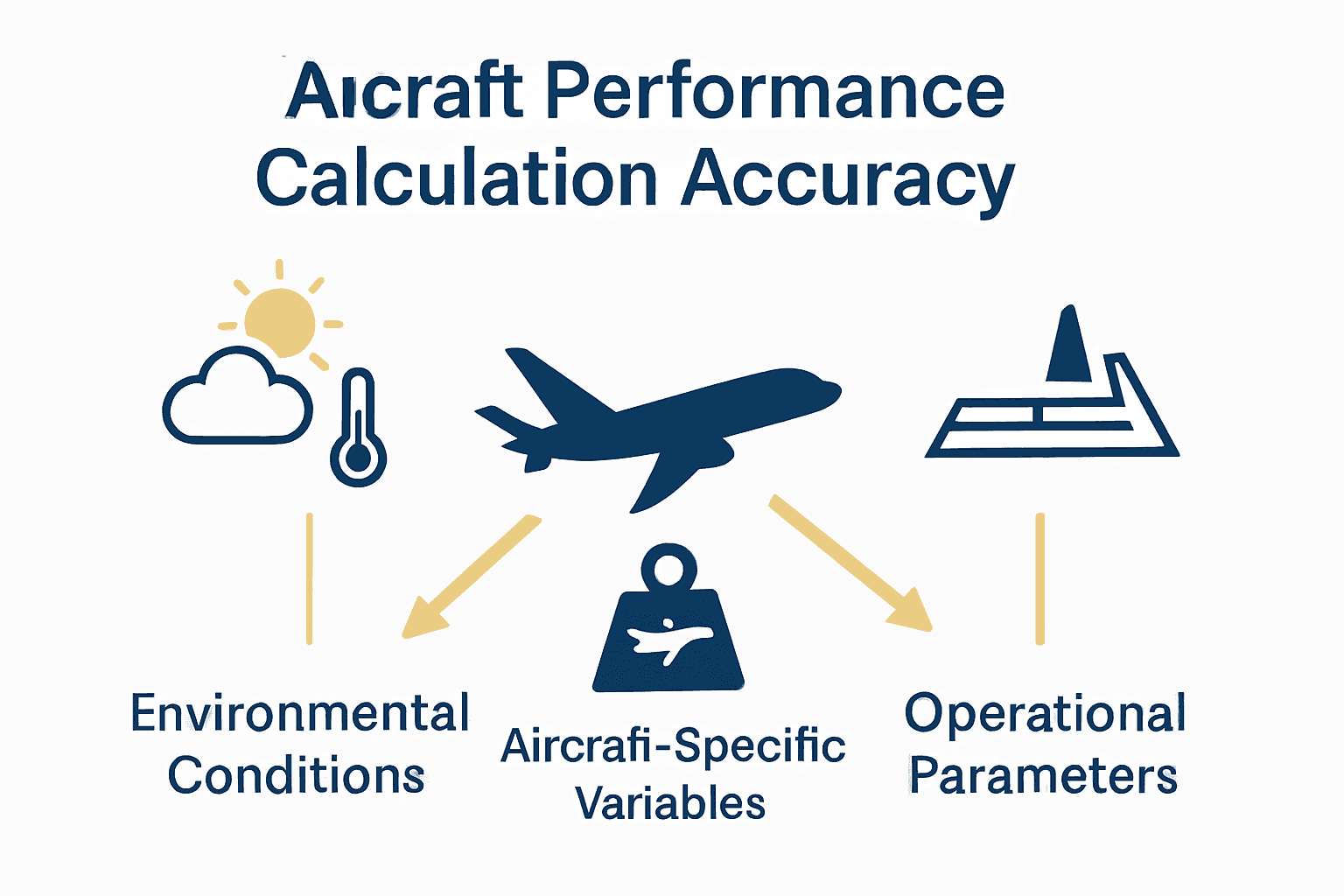
The key factors influencing performance calculation accuracy include:
-
Environmental Conditions
- Atmospheric temperature and pressure
- Wind speed and direction
- Humidity levels
- Altitude variations
-
Aircraft-Specific Variables
- Current aircraft weight
- Fuel load distribution
- Centre of gravity positioning
- Mechanical system status
-
Operational Parameters
- Runway surface conditions
- Runway length and slope
- Obstacle clearance requirements
- Meteorological limitations
As highlighted in the EASA documentation, data source validation is paramount. Pilots and flight engineers must rigorously test computational models against Aircraft Flight Manual (AFM) data, ensuring corner-point testing and comprehensive environmental condition coverage. This meticulous approach helps identify potential discrepancies that could compromise calculation reliability.
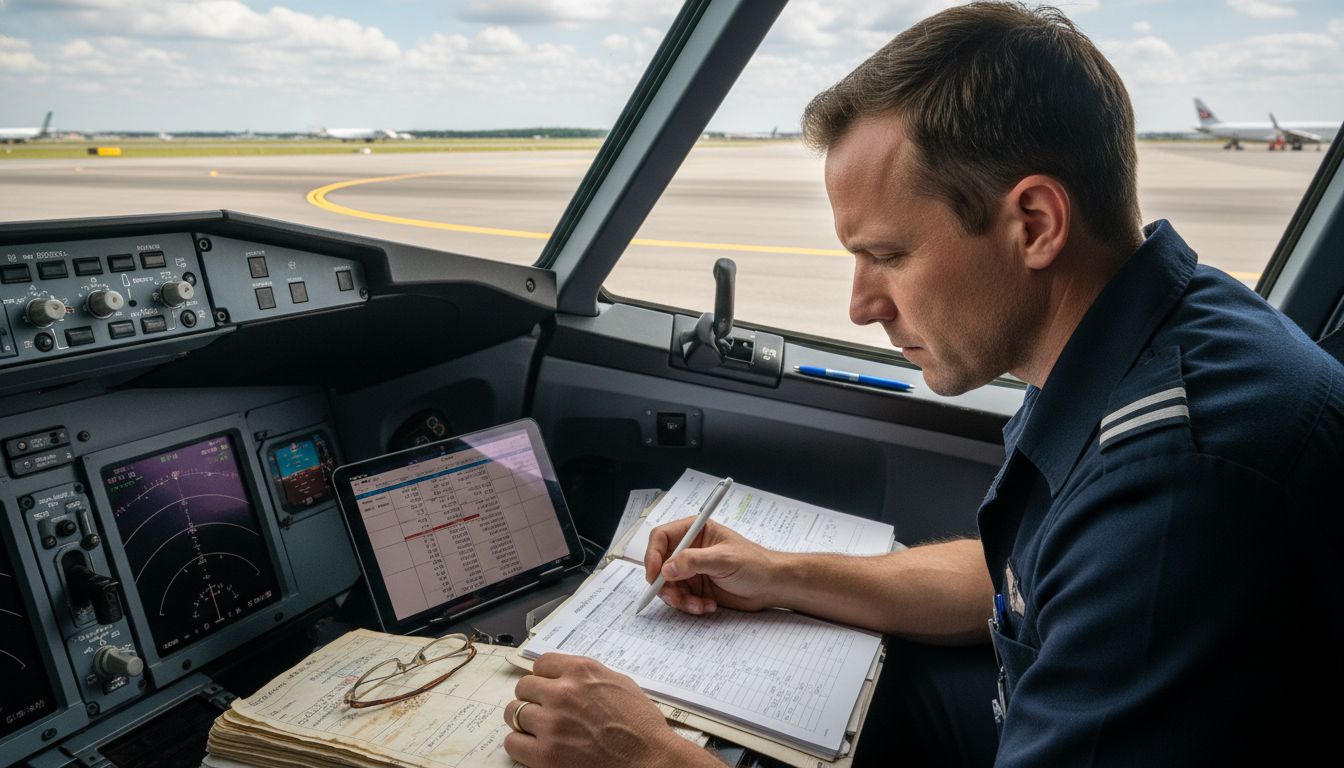
Technological advancements have introduced sophisticated Electronic Flight Bag (EFB) applications that enhance calculation precision.
 However, these tools are not infallible. Successful performance calculations require a blend of technological support and human expertise, demanding continuous professional training, situational awareness, and a deep understanding of the complex variables that influence aircraft performance across diverse operational scenarios.
EASA Regulations on Performance Calculations
The European Union Aviation Safety Agency (EASA) establishes comprehensive regulatory frameworks that govern aircraft performance calculations, ensuring standardized safety and operational excellence across commercial aviation. According to the EASA Easy Access Rules for Air Operations, these regulations mandate precise methodologies for calculating critical performance parameters across various flight stages.
Key regulatory requirements for performance calculations include:
- Mandatory Calculation Categories
- Take-off performance assessments
- Climb gradient evaluations
- En-route performance measurements
- Landing distance calculations
- Brake energy computations
- Extended-range Twin-engine Operational Performance (ETOPS) analyses
- Compliance Standards
- Alignment with Aircraft Flight Manual (AFM) data
- Comprehensive environmental condition testing
- Validation across entire operational envelope
- Standardized computational methodologies
As detailed in the EASA Safety Information Bulletin, operators utilizing Electronic Flight Bag (EFB) applications must rigorously validate performance calculation tools. This involves extensive corner-point testing and ensuring computational accuracy under diverse operational scenarios covered under Part-CAT and Part-NCC regulations.
The regulatory landscape demands continuous professional development and technological adaptation. While EASA regulations on performance calculations provide a robust framework, pilots and flight engineers must combine regulatory compliance with advanced computational skills and situational awareness to maintain the highest standards of aviation safety.
Common Errors and Safety Implications
Aircraft performance calculation errors can have catastrophic consequences, transforming seemingly minor miscalculations into potentially life-threatening situations. According to EASA Safety Information Bulletin, even small mistakes in performance data can lead to runway overruns, tail strikes, or complete aircraft loss.
The most critical performance calculation errors include:
Critical Data Entry Mistakes
- Incorrect zero fuel weight calculations
- Misselection of performance charts
- Outdated flight performance data
- Unit conversion errors
- Incorrect mass and centre of gravity values
- Flap configuration misunderstandings
- Inappropriate V-speed selections
Potential Safety Consequences
- Runway excursion risks
- Insufficient climb performance
- Increased stall probability
- Compromised aircraft control
- Reduced obstacle clearance margins
- Fuel consumption miscalculations
- Increased structural stress
These errors often stem from complex interactions between human factors and technological systems. Pilots must develop rigorous cross-checking mechanisms, maintaining constant situational awareness and skepticism towards computational outputs. While Electronic Flight Bag (EFB) technologies provide sophisticated calculation tools, they cannot replace fundamental computational skills and comprehensive understanding of aircraft performance principles.
Continuous training, systematic verification processes, and a culture of meticulous attention to detail remain the most effective safeguards against performance calculation errors. Professionals must cultivate an approach that combines technological proficiency with critical thinking, ensuring that every calculation receives thorough scrutiny before implementation.
Practical Uses in Pilot Training and Operations
Performance calculations are fundamental skills that transform theoretical knowledge into practical operational expertise for pilots. According to the EASA Aircrew Regulation, comprehensive training requires pilots to become proficient in utilizing flight manuals, performance charts, and computational tables across various operational scenarios.
Key Training and Operational Applications:
- Pre-Flight Planning
- Weight and balance calculations
- Fuel requirement assessments
- Route performance analysis
- Runway suitability evaluations
- Obstacle clearance determinations
- In-Flight Decision Making
- Real-time performance monitoring
- Adaptive route optimization
- Fuel consumption tracking
- Emergency scenario planning
- Weather impact assessments
- Simulation and Skill Development
- Performance chart interpretation
- Complex computational scenarios
- Critical thinking development
- Error recognition training
- Systematic verification processes
Modern pilot training approaches for online learning increasingly integrate sophisticated performance calculation methodologies. These programs emphasize not just computational accuracy, but developing a holistic understanding of how performance calculations directly influence flight safety, operational efficiency, and strategic decision-making.
Beyond technical proficiency, performance calculation training cultivates a mindset of precision, adaptability, and continuous situational awareness. Pilots must learn to seamlessly integrate technological tools with fundamental computational skills, transforming complex mathematical models into practical, life-saving operational insights that ensure safe and efficient flight operations.
Master Aircraft Performance Calculations with Confidence
Navigating the complexities of aircraft performance calculations demands precision and deep understanding. This article highlights the crucial challenges pilots face, such as accurate takeoff and landing data, fuel consumption projections, and ensuring compliance with stringent EASA regulations. If you aim to transform these critical concepts into practical skills without the stress of traditional classrooms, VictorOne’s Academy – VictorOne offers expertly designed, fully online courses tailored to your needs.

Take control of your aviation career today by joining a platform built for aspiring and professional pilots alike. Our flexible training approach empowers you to master essential topics such as climb gradients, obstacle clearance, and en-route performance calculations from anywhere in the world. Visit VictorOne now and explore how our comprehensive aviation education can propel you forward. Dive deeper into the operational side with resources found in Aircraft – VictorOne and begin your journey to becoming a skilled aviator who understands every aspect of flight safety and efficiency.
Frequently Asked Questions
What are aircraft performance calculations?
Aircraft performance calculations are systematic mathematical evaluations that determine an aircraft’s operational capabilities, efficiency, and safety across various flight conditions. They assess parameters such as takeoff and landing distances, fuel consumption rates, and climb performance.
Why are performance calculations important in aviation?
Performance calculations are crucial in aviation as they ensure that aircraft operate within safe performance envelopes. They directly impact flight planning, operational decision-making, and overall flight safety by preventing potential operational risks during different flight phases.
What factors affect the accuracy of aircraft performance calculations?
The accuracy of aircraft performance calculations can be influenced by environmental conditions such as temperature and wind, aircraft-specific variables like weight and fuel load, and operational parameters including runway conditions and obstacle clearances.
What types of performance calculations are essential for pilots?
Essential types of performance calculations for pilots include takeoff performance, landing performance, and en-route performance calculations. Each category encompasses key metrics that ensure safe and efficient aircraft operations.