Did you know that over 70 percent of aviation incidents are linked to human factors rather than equipment failure? This reality puts a spotlight on the importance of safety culture within every aviation organization. A strong safety culture not only protects lives but also builds trust and reliability across all levels of operation. Understanding what shapes safety mindsets and behaviors provides practical tools for safer skies and more resilient flight operations.
Key Takeaways
| Point | Details |
|---|---|
| Safety Culture is Holistic | Safety culture encompasses shared values and practices that prioritize risk management beyond mere compliance with rules. |
| Maturity Levels of Safety Culture | Organizations progress through various maturity stages, from compliance-focused to fully integrated safety practices. |
| Importance of Communication | Open communication and a ‘just culture’ are essential for fostering a positive safety environment and encouraging proactive reporting. |
| Proactive Risk Management | Continuous learning and adaptive strategies are crucial in managing safety risks, especially during periods of organizational change. |
Table of Contents
- Defining Aviation Safety Culture And Key Concepts
- Core Elements Shaping Safety Behaviour
- Types And Maturity Levels Of Safety Culture
- Easa Regulations And International Standards
- Best Practices In Promoting Safety Culture
- Common Risks, Pitfalls, And Mitigation Strategies
Defining Aviation Safety Culture and Key Concepts
In the complex world of aviation, safety culture represents far more than a set of rules. It’s a comprehensive approach to understanding, managing, and preventing potential risks across every operational level. Read more about safety procedures in our comprehensive guide to appreciate the depth of this critical concept.
According to the European Union Aviation Safety Agency (EASA), safety culture is an enduring set of values, norms, attitudes, and practices within an organisation focused on minimising exposure to hazardous conditions. This definition highlights that safety isn’t just about following procedures, but cultivating a shared mindset where every team member feels personally responsible for maintaining high safety standards.
Key characteristics of a robust aviation safety culture include:
- Shared commitment to identifying and mitigating potential risks
- Open communication about safety concerns without fear of punishment
- Proactive approach to understanding systemic vulnerabilities
- Continuous learning and improvement mentality
- Individual and collective accountability for safety outcomes
“Safety is not an intellectual exercise to keep us in work. It is a matter of life and death. It is the sum of our contributions to safety.” – Unknown Aviation Safety Expert
A positive safety culture goes beyond compliance; it creates an environment where safety becomes an intrinsic part of organisational DNA. It transforms safety from a mandatory checklist into a dynamic, evolving commitment that adapts to changing operational landscapes and technological advancements.
Core Elements Shaping Safety Behaviour
Shaping safety behaviour is a complex process that requires strategic interventions and comprehensive understanding. Learn more about aviation safety management practices to appreciate the intricate dynamics of behavioural transformation in high-risk environments.
According to the European Union Aviation Safety Agency (EASA), Safety Promotion emerges as a critical enabler in influencing and modifying safety-related behaviours. This approach goes beyond traditional training methods, utilizing a multi-faceted toolkit including:
- Detailed safety reports
- Comprehensive guidance documents
- Targeted awareness campaigns
- Interactive industry events
- Best-practice knowledge sharing platforms
The fundamental goal of these interventions is not merely to inform, but to create a psychological shift in how aviation professionals perceive, understand, and respond to potential safety risks.
 This transformation requires addressing both individual psychological factors and broader organisational cultural dynamics.
“Behaviour is a mirror in which every person shows their image.” – Johann Wolfgang von Goethe
Effective safety behaviour shaping involves understanding human factors, implementing targeted learning strategies, and creating an environment that encourages proactive risk identification. It’s about developing a systemic approach that empowers individuals to make safer choices not out of compliance, but from a genuine understanding of potential consequences and personal responsibility.
Types and Maturity Levels of Safety Culture
Safety culture is not a static concept but a dynamic framework with varying levels of sophistication and implementation. Explore our comprehensive guide on understanding human factors to gain deeper insights into how organisational dynamics influence safety perceptions.
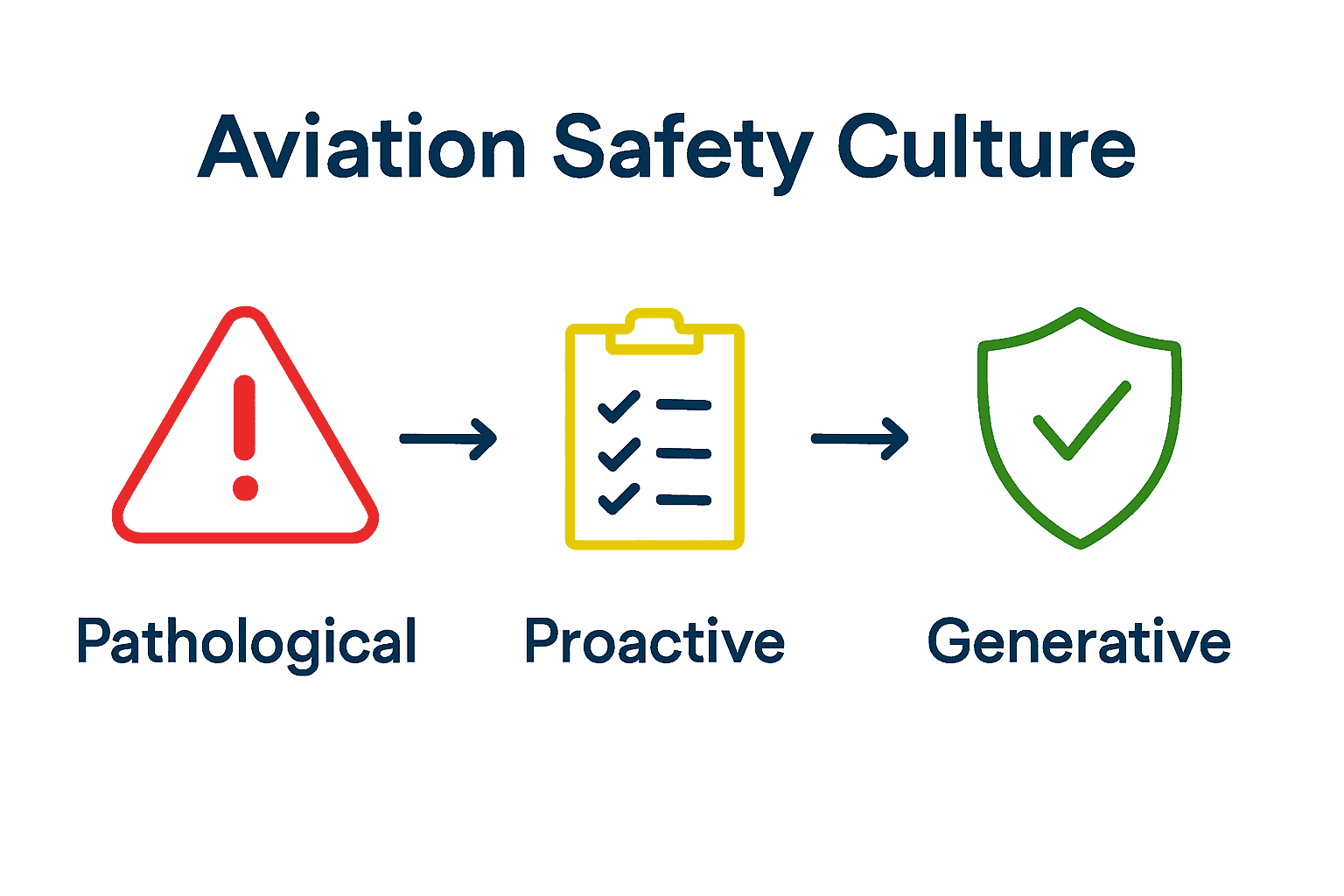
According to the European Union Aviation Safety Agency (EASA), safety culture maturity can be categorized across different developmental stages. These stages represent an organisation’s progression in embedding safety as a core operational principle:
- Pathological Stage: Safety is seen as a compliance issue, with minimal genuine commitment
- Reactive Stage: Safety responses are triggered only after incidents occur
- Calculative Stage: Systematic approaches are implemented with standardized safety management processes
- Proactive Stage: Active risk identification and preventative strategies are prioritized
- Generative Stage: Safety is fully integrated into organisational culture and decision-making
EASA’s European Commercial Aviation Safety Team (ECAST) best practice materials highlight that safety culture serves as a critical enabler of Safety Management Systems (SMS), supporting organisations in meeting international standards and continuously improving their safety practices.
“Safety is not an endpoint, but a continuous journey of learning and improvement.”
The maturity progression involves developing robust organisational competencies, enhancing communication mechanisms, and fostering an environment where every team member feels empowered and responsible for maintaining safety standards. It’s a transformative process that goes beyond mere compliance, creating a sustainable approach to risk management and operational excellence.
EASA Regulations and International Standards
Explore our comprehensive guide on aviation safety procedures to understand how regulatory frameworks shape the aviation industry’s safety landscape. The European Union Aviation Safety Agency (EASA) plays a pivotal role in establishing robust standards that go far beyond simple compliance, embedding safety culture into the legal and regulatory framework of aviation operations.
EASA’s easy-access rules provide comprehensive definitions of critical safety concepts, including safety culture, just culture, organisational factors, and human factors. These definitions are not merely academic exercises but serve as fundamental building blocks for creating a holistic approach to aviation safety. According to EASA’s regulatory documentation, these principles are strategically integrated to:
- Establish clear expectations for safety management
- Create accountability mechanisms
- Promote transparent reporting cultures
- Develop systematic risk mitigation strategies
In a significant regulatory development, EASA has reinforced its commitment to safety culture through ground-handling regulations. These new EU rules explicitly incorporate just culture principles, demonstrating a progressive approach to safety management that recognizes the complex human elements underlying aviation operations.
“Regulations are not just rules, but a pathway to creating safer skies for everyone.”
The international standards developed by EASA represent more than bureaucratic documentation; they are a sophisticated framework designed to transform safety from a theoretical concept into a practical, lived experience across all levels of aviation operations. By embedding safety culture into legal requirements, these regulations create a comprehensive ecosystem that encourages continuous improvement, transparent communication, and proactive risk management.
Best Practices in Promoting Safety Culture
Learn more about human factors in aviation safety to comprehend the intricate psychological foundations of safety culture promotion. Developing an effective safety culture requires a strategic, multi-dimensional approach that goes beyond traditional training methodologies.
According to the European Union Aviation Safety Agency (EASA), promoting safety culture involves leveraging diverse communication channels and engagement strategies. The recommended toolkit for safety promotion encompasses:
- Targeted publications and industry reports
- Comprehensive awareness campaigns
- Interactive workshops and training sessions
- Practical safety toolkits
- Collaborative safety promotion networks
The European Commercial Aviation Safety Team (ECAST) best practice material provides critical guidance for organisations seeking to implement robust Safety Management Systems (SMS). These guidelines focus on three fundamental areas:
- Organisational Structure: Establishing clear safety accountability
- Hazard Identification: Developing systematic risk detection mechanisms
- Risk Assessment: Creating adaptive mitigation strategies
“Safety is not a destination, but a continuous journey of learning, adaptation, and commitment.”
Effective safety culture promotion transcends mere compliance. It requires creating an environment where safety becomes an intrinsic value, not an external requirement. This means fostering open communication, encouraging proactive reporting, recognizing safety achievements, and continuously evolving organisational practices to address emerging challenges and technological advancements.
Common Risks, Pitfalls, and Mitigation Strategies
Dive deeper into understanding aviation safety procedures to comprehend the complex landscape of risk management in aviation safety culture. Identifying and addressing potential risks requires a sophisticated, proactive approach that goes beyond traditional reactive strategies.
According to the European Union Aviation Safety Agency (EASA), several key risks and potential pitfalls can undermine an organisation’s safety culture, particularly during periods of organisational change. These critical risk areas include:
- Communication breakdowns
- Inconsistent safety standards
- Insufficient error reporting mechanisms
- Lack of systematic risk assessment
- Resistance to cultural transformation
EASA recommends comprehensive mitigation strategies that focus on:
- Internal Investigations: Implementing transparent, non-punitive investigation processes
- Safety Performance Monitoring: Establishing robust tracking and evaluation systems
- Management of Change: Developing adaptive frameworks for organisational transitions
- Continuous Improvement: Creating iterative feedback and learning mechanisms
“In aviation, understanding risks is not about preventing failure, but about creating resilient systems that can learn and adapt.”
The most effective mitigation approach embraces a just culture philosophy, where the focus shifts from blame to understanding and systematic improvement. This means creating an environment that encourages open reporting, values learning from incidents, and views errors as opportunities for organisational growth rather than individual punishment.
Elevate Your Understanding of Aviation Safety Culture with VictorOne Academy
Building a strong safety culture is more than a goal. It is a crucial requirement for every future pilot. If you recognise the massive responsibility of maintaining a proactive safety culture and want to master the concepts of risk management, just culture, and human factors discussed in this guide, VictorOne Academy offers you the right foundation to succeed. Our EASA-approved online courses cover safety management, human factors, and everything you need for real-world confidence.
Are you ready to turn theory into practice and become part of a new generation of safety-focused aviators? Visit VictorOne.eu to explore our comprehensive online programmes and flexible learning tools that make safety culture an integral part of your career journey. Take the first step now and secure your path to certification and professional excellence.
Frequently Asked Questions
What is aviation safety culture?
Aviation safety culture is an enduring set of values, norms, attitudes, and practices within an organization focused on minimizing exposure to hazardous conditions. It encompasses not just compliance with rules but a shared mindset where every team member feels responsible for maintaining high safety standards.
What are the key characteristics of a strong safety culture in aviation?
Key characteristics include a shared commitment to risk identification, open communication about safety concerns, a proactive approach to understanding vulnerabilities, a mentality of continuous learning and improvement, and a sense of individual and collective accountability for safety outcomes.
How does EASA define safety culture maturity levels?
EASA defines safety culture maturity across several stages: Pathological, Reactive, Calculative, Proactive, and Generative. These stages indicate an organization’s progression in embedding safety as a core operational principle, ranging from minimal commitment to full integration of safety culture in decision-making processes.
What are effective strategies for promoting safety culture in aviation organizations?
Effective strategies include leveraging diverse communication channels, conducting targeted awareness campaigns, implementing interactive workshops, ensuring clear safety accountability, and developing systematic risk detection and assessment mechanisms.