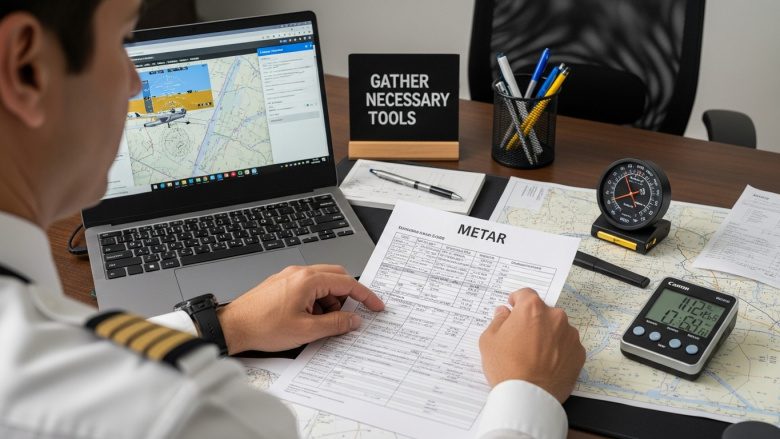
Most british pilots know that aviation weather sources can make or break a flight plan. With the growing unpredictability of European weather, accurate data is now more crucial than ever for pilot safety. Over 90 percent of aviation incidents have weather as a contributing factor. This guide unpacks the key official, commercial, and automated systems pilots rely on, showing how mastering these resources will strengthen your certification journey and everyday decision making.
Table of Contents
- Defining Aviation Weather Sources and Their Role
- Key Types: Official, Commercial, Automated Systems
- Comparing Data Accuracy and Real-Time Updates
- EASA Regulations on Weather Information Usage
- Common Pitfalls and Best Practices for Pilots
Key Takeaways
| Point | Details |
|---|---|
| Importance of Multiple Sources | Always cross-reference multiple weather sources to gain a comprehensive understanding of atmospheric conditions. |
| Value of Accurate Reporting | Official meteorological services provide the highest standards of verification for weather data accuracy. |
| Proactive Decision-Making | Pilots should establish strict personal minimums and avoid risky continuation bias under changing weather conditions. |
| EASA Regulations Compliance | Maintain a detailed logbook of weather briefings to demonstrate compliance with EASA regulatory frameworks. |
Defining Aviation Weather Sources and Their Role
Aviation weather sources represent a critical infrastructure of meteorological data and communication systems designed to provide pilots with precise, real-time atmospheric information essential for flight safety. Understanding meteorological data sources becomes increasingly important as climate change introduces more complex and unpredictable weather patterns across European airspace.
These weather sources encompass a comprehensive range of reporting mechanisms, including surface observations, pilot reports (PIREPs), satellite imagery, radar systems, and sophisticated computer-generated forecasting models. Each source contributes unique atmospheric insights, enabling pilots to make informed decisions about route planning, potential hazards, and operational risk management. Ground-based meteorological stations, weather balloons, and automated weather observation systems continuously collect critical data points such as temperature, wind speed, visibility, cloud cover, and precipitation.
The European aviation sector relies on standardised weather reporting formats like METAR (Meteorological Aerodrome Report) and TAF (Terminal Aerodrome Forecast) to communicate complex atmospheric conditions quickly and consistently. These internationally recognised codes provide pilots with condensed yet comprehensive weather snapshots, allowing rapid assessment of potential flight challenges. Professional pilots must develop advanced skills in interpreting these technical reports, understanding the nuanced information embedded within seemingly cryptic alphanumeric sequences.
Pro tip: Always cross-reference multiple weather sources before making critical flight decisions, ensuring a comprehensive understanding of atmospheric conditions beyond a single reporting mechanism.
Key Types: Official, Commercial, Automated Systems
In the complex world of aviation meteorology, weather sources are categorised into three primary systems: official, commercial, and automated, each playing a unique role in providing critical atmospheric information. Automated weather observation systems have revolutionised the way pilots receive real-time meteorological data, offering unprecedented precision and consistency in reporting.
Official weather sources, typically managed by national meteorological agencies like the United Kingdom’s Met Office or the European Organisation for the Safety of Air Navigation (EUROCONTROL), provide standardised, government-validated weather reports. These sources utilise extensive networks of ground stations, weather balloons, and satellite technologies to collect comprehensive atmospheric data. Commercial weather services, such as specialised aviation meteorological companies, complement official sources by offering detailed, tailored forecasting and additional interpretative analysis that goes beyond standard reporting mechanisms.
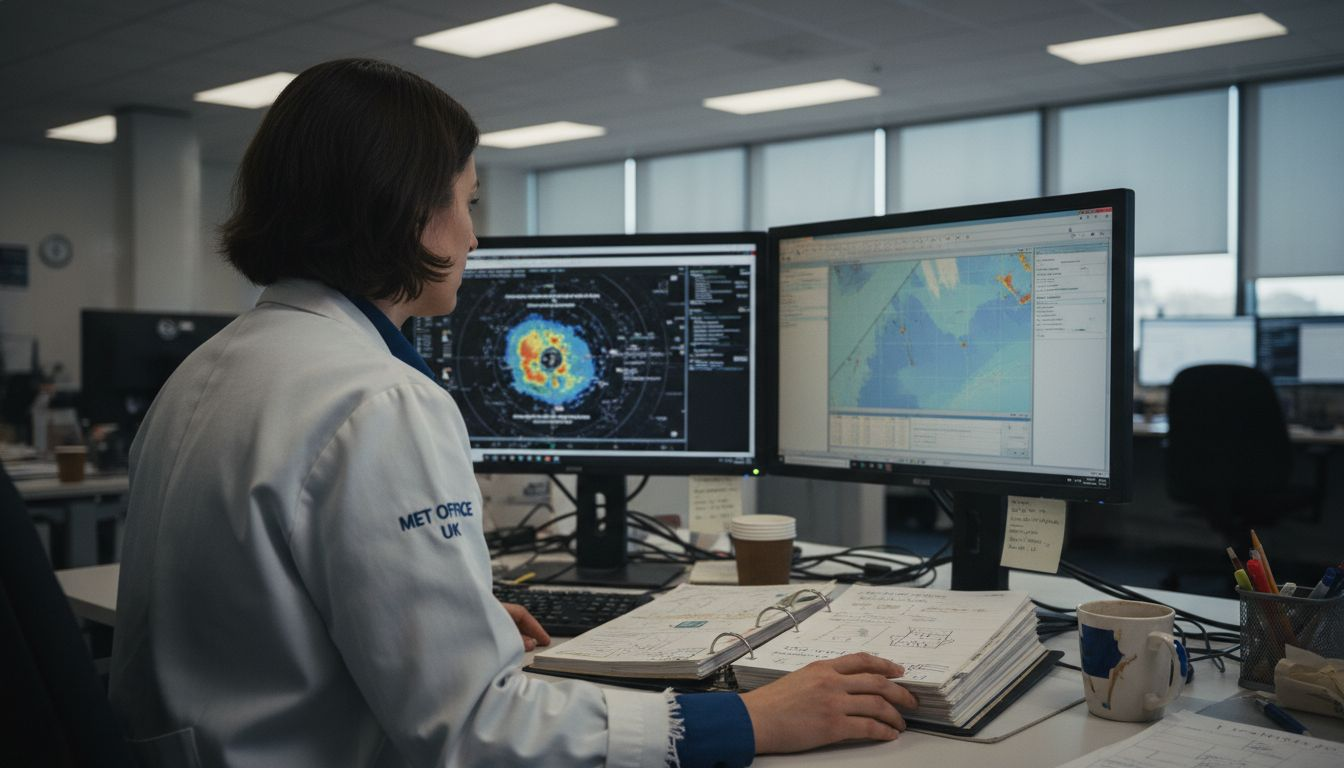
Automated systems represent the technological pinnacle of weather reporting, employing sophisticated sensors and computer algorithms to generate instantaneous meteorological observations. These systems, including Automated Weather Observing Systems (AWOS) and Automated Surface Observing Systems (ASOS), continuously monitor critical parameters like temperature, wind direction, visibility, cloud cover, and atmospheric pressure. By eliminating human error and providing near-instantaneous updates, automated systems have become an indispensable tool for pilots navigating increasingly complex atmospheric conditions.
Pro tip: Always verify automated weather reports by cross-referencing multiple sources, as technological systems can occasionally experience calibration or sensor limitations.
Here’s a quick comparison of the primary aviation weather source types and their unique advantages:
| Source Type | Key Strength | Example Use Case |
|---|---|---|
| Official | Government-validated | Regulatory compliance briefing |
| Commercial | Customised analysis | Route-specific hazard reports |
| Automated | Instant updates | Rapid airport condition check |
Comparing Data Accuracy and Real-Time Updates
Accuracy in aviation weather reporting represents a critical intersection of technology, human expertise, and systematic data verification. Real-time aviation weather data streams have transformed how pilots assess and respond to atmospheric conditions, providing unprecedented levels of precision and immediacy in meteorological information.
The accuracy of weather sources varies considerably across different systems, with each approach presenting unique strengths and potential limitations. Official meteorological services typically maintain the highest standards of verification, employing rigorous scientific protocols and multiple cross-referencing mechanisms. These sources utilise extensive networks of ground stations, satellite observations, and sophisticated computational models to generate comprehensive weather analyses. Commercial weather services often augment official data by providing specialised interpretations and predictive models tailored specifically to aviation requirements, offering nuanced insights that go beyond standard reporting parameters.
Automated systems introduce remarkable technological capabilities in data collection and transmission, capable of generating instantaneous updates with minimal human intervention. However, these systems are not infallible and may occasionally encounter calibration challenges or sensor limitations. Professional pilots understand the importance of cross-referencing multiple sources, recognising that while automated systems provide rapid information, human judgment and comprehensive analysis remain essential for interpreting complex meteorological conditions. Advanced aviation professionals develop skills in critically evaluating weather reports, understanding the subtle variations and potential discrepancies between different reporting mechanisms.
Pro tip: Develop a systematic approach to weather data verification by comparing at least three independent sources before making critical flight decisions.
EASA Regulations on Weather Information Usage
EASA has established comprehensive regulatory frameworks governing the collection, interpretation, and application of weather information in European aviation, with specific guidelines for pilots’ weather information usage designed to enhance operational safety and standardise meteorological decision-making processes.
The regulatory approach focuses on multiple critical dimensions of weather information management. Operators are mandated to develop robust procedures for obtaining, verifying, and utilising meteorological data across various flight phases. These regulations require comprehensive training programmes that equip pilots with advanced skills in interpreting complex weather reports, understanding potential atmospheric hazards, and making informed decisions based on sophisticated meteorological insights. The guidelines emphasise the importance of integrating electronic information systems, promoting real-time connectivity, and ensuring pilots have access to the most current and accurate atmospheric data.
Recent amendments to EASA’s Air Operations Regulation, specifically ED Decision 2022/012/R, have introduced technology-neutral approaches that provide greater flexibility while maintaining stringent safety standards. These updated regulations address the evolving technological landscape by establishing clear operator responsibilities for weather information management, mandating advanced aircraft system integration, and developing comprehensive procedures for managing low-visibility and adverse meteorological conditions. The framework ensures that European aviation maintains a proactive approach to weather-related risk mitigation, balancing technological innovation with rigorous safety protocols.
Pro tip: Always maintain a detailed logbook of weather briefings and decisional rationales to demonstrate compliance with EASA regulatory requirements and enhance your professional documentation.
Common Pitfalls and Best Practices for Pilots
Aviation safety hinges critically on understanding and mitigating weather-related risks through proactive decision-making and comprehensive situational awareness. Navigating the complex challenges of visual flight into instrument meteorological conditions represents one of the most significant challenges for pilots seeking to maintain operational safety.
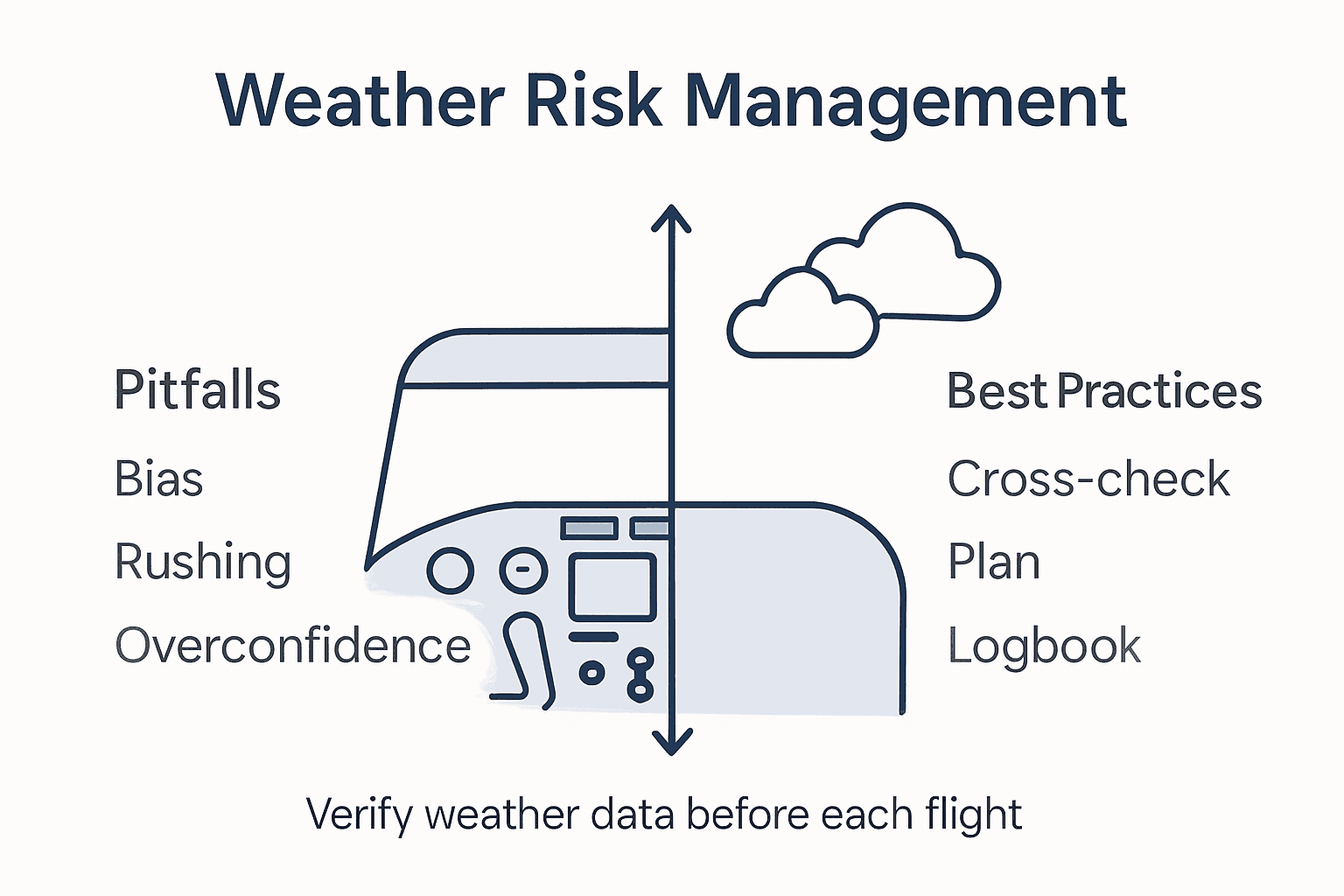
Common pitfalls in weather assessment include dangerous psychological traps such as continuation bias, where pilots persist with their original flight plan despite emerging meteorological hazards. Pilots frequently underestimate the rapid deterioration of atmospheric conditions, failing to update their situational awareness or establish realistic personal minimums for safe operations. The most critical errors involve inadequate preflight preparation, insufficient understanding of local terrain and microclimate interactions, and an overconfident approach to marginal weather conditions that can quickly transform from manageable to life-threatening.
Best practices demand a multifaceted approach to weather risk management. Professional pilots must develop rigorous preflight briefing protocols, continuously monitor atmospheric changes, and maintain conservative decision-making strategies. This involves establishing personal minimums more restrictive than regulatory requirements, cultivating a disciplined approach to interpreting meteorological data, and developing the psychological resilience to abort missions when conditions exceed safe operational parameters. Technological tools and comprehensive training programmes provide critical support, but ultimately, individual judgment and a commitment to safety culture remain the most important defensive mechanisms against weather-related aviation incidents.
Below is a summary of common pilot pitfalls and best practices in weather risk management:
| Challenge | Description | Best Practice |
|---|---|---|
| Continuation bias | Ignoring worsening conditions due to plan focus | Set objective abort criteria |
| Underestimating changes | Failing to revise decisions as weather shifts | Monitor conditions actively |
| Overconfidence | Taking risks in marginal situations | Establish strict minima |
Pro tip: Create a personal weather decision flowchart that objectively defines your abort criteria, removing emotional bias from critical flight safety decisions.
Enhance Your Flight Safety with Comprehensive Pilot Training
Mastering aviation weather sources is essential for every pilot aiming to fly safely in complex and changing atmospheric conditions. This article highlights the critical challenge of interpreting real-time weather data from official, commercial, and automated systems while complying with EASA regulations. Understanding terms like METAR and TAF and avoiding pitfalls such as continuation bias require more than curiosity — they demand rigorous training and practical knowledge.

Take control of your aviation career by building expert skills at VictorOne.eu. Our fully online, EASA-approved theoretical courses cover all necessary competencies including advanced meteorological understanding, risk management, and regulatory compliance. Whether you aspire to fly fixed-wing or rotorcraft, explore specialised pathways in our Aircraft – VictorOne category designed to prepare you for real-world challenges. Embrace flexibility with interactive modules and exam preparation tailored for international aviation professionals.
Start your journey to confident, weather-wise piloting today. Visit VictorOne.eu and discover how our expert training transforms your knowledge into safe, professional decision-making.
Frequently Asked Questions
What are aviation weather sources?
Aviation weather sources are systems designed to provide pilots with precise, real-time atmospheric information essential for flight safety. These include surface observations, pilot reports (PIREPs), satellite imagery, radar systems, and computer-generated forecasts.
How do official, commercial, and automated weather sources differ?
Official sources are government-validated reports, commercial sources provide tailored analyses, and automated systems generate real-time updates using sophisticated sensors. Each type has its strengths and weaknesses in terms of accuracy and reliability.
Why is real-time accuracy important in aviation weather conditions?
Real-time accuracy is crucial for pilots to make informed decisions about flight planning and safety, as weather conditions can change rapidly. Accurate data helps in assessing potential hazards and managing operational risks effectively.
What are some common pitfalls pilots face when assessing weather conditions?
Common pitfalls include continuation bias, where pilots stick to their original flight plans despite worsening conditions, underestimating rapid changes in weather, and overconfidence when flying in marginal conditions. Recognising these pitfalls is key to enhancing flight safety.
Recommended
- Meteorology for Pilots: Complete Guide – VictorOne
- How to Study Meteorology for Pilots and Aviation Pros – VictorOne
- How to Read METARs for Accurate Flight Planning – VictorOne
- Aviation Safety Management Systems: Key Practices Explained – VictorOne
- Hawaiian Wind Simulation Effects: Enhancing Flight Of Aloha | Flight Of Aloha