Most advice about flight time regulations overlooks how rigorously European standards shape the daily realities of british pilots. With the European Union Aviation Safety Agency enforcing strict limits, a single miscalculation can breach compliance and increase fatigue risks. These flight time limitations directly impact more than 95% of airline crew schedules across the continent. Understanding these rules is crucial for anyone navigating british or wider European aviation environments, helping professionals stay both safe and legally protected.
Table of Contents
- Defining EASA Flight Time Limitations And Scope
- Categorising Flight And Duty Periods Explained
- Core EASA FTL Regulations And Legal Framework
- Calculating Rest, Duty, And Block Time
- Compliance Obligations And Common Mistakes
Key Takeaways
| Point | Details |
|---|---|
| Comprehensive Regulations | EASA establishes detailed flight time limitations under Regulation (EU) No 965/2012 to manage pilot fatigue and ensure safety. |
| Categorisation of Duty Periods | Understanding flight and duty period classifications is essential for compliance and optimal pilot well-being. |
| Proactive Compliance | Maintaining accurate logs and actively tracking rest and duty periods prevents fatigue-related risks and regulatory breaches. |
| Dynamic Legal Framework | EASA regulations evolve continually, requiring operators to stay informed about updates and best practices in fatigue management. |
Defining EASA Flight Time Limitations and Scope
The European Union Aviation Safety Agency (EASA) establishes comprehensive flight time limitations designed to manage pilot fatigue and ensure operational safety. Flight time limitations represent critical regulatory guidelines that define the maximum hours a pilot can be actively flying and on duty within specific timeframes, directly impacting aviation professional wellbeing.
These limitations are meticulously structured under Regulation (EU) No 965/2012, which provides a detailed framework for managing crew alertness and preventing fatigue-related risks. The regulations cover multiple aspects including maximum daily flight times, mandatory rest periods, weekly limitations, and cumulative flight hour restrictions. Pilots must adhere to these scientifically developed guidelines to maintain high safety standards and protect their physical and mental health during complex aviation operations.
The EASA flight time limitations consider several nuanced factors that influence pilot performance. These include circadian rhythms, cumulative fatigue, time zone transitions, and individual physiological variations. By implementing such comprehensive regulations, EASA aims to create a standardised approach to managing pilot workload across European aviation environments, recognising that human performance can significantly degrade with prolonged duty periods and insufficient recovery time.
Pro Tip: Careful Documentation: Maintain a personal log of your flight hours and rest periods, even beyond official requirements, to proactively monitor your fatigue levels and ensure personal safety standards are consistently met.
Categorising Flight and Duty Periods Explained
Understanding the nuanced categorisation of flight and duty periods is crucial for maintaining aviation safety and pilot wellbeing. Flight duty period classifications represent complex regulatory frameworks that define precise boundaries for pilot work schedules, encompassing multiple distinct segments of professional aviation activity.
The EASA regulations distinguish between several critical categories of time periods. Flight duty periods (FDP) specifically represent the total time from when a pilot reports for duty until the completion of a flight or series of flights. This includes pre-flight preparation, actual flying time, and post-flight administrative responsibilities. Additionally, standby periods are defined as times when pilots are required to be available for potential duty assignments, but have not yet been activated for specific flight responsibilities.
Within these classifications, pilots encounter intricate subcategories that account for various operational scenarios. Split duty periods, for instance, allow for potential rest intervals during extended duty assignments, recognising the physiological need for recovery. These regulations meticulously account for travelling time, pre-flight preparations, and post-flight activities, ensuring a comprehensive approach to managing pilot fatigue and maintaining operational safety standards across European aviation environments.
Here is a concise summary of key EASA time period definitions relevant for pilots:
| Term | Definition | Typical Usage |
|---|---|---|
| Block Time | From first movement to final stop of aircraft | Calculation of flying hours |
| Duty Time | Total time spent on aviation-related activities | Determines legal duty duration |
| Flight Duty Period (FDP) | Time from reporting for duty through flight(s) completion | Sets work schedule boundaries |
| Standby Period | Time pilot is available for potential duty | Required rest and alertness |
| Split Duty | Duty split by authorised rest interval | Fatigue mitigation on long ops |
Pro Tip: Detailed Tracking: Maintain a personal, comprehensive log of all duty periods, including flight times, standby hours, and rest intervals, to proactively manage your professional schedule and ensure compliance with EASA regulations.
Core EASA FTL Regulations and Legal Framework
The European aviation regulatory landscape is underpinned by comprehensive legal frameworks designed to ensure pilot safety and operational efficiency. Core legal instruments governing flight time limitations are primarily embodied in Regulation (EU) No 965/2012, which establishes detailed and scientifically informed standards for managing pilot work schedules and fatigue mitigation.

Central to these regulations are the Operational Requirements (ORO) subsection, specifically ORO‑FTL, which meticulously defines the legal boundaries of flight duty periods, rest requirements, and maximum working hours. These regulations apply comprehensively across commercial air transport operations, encompassing both fixed-wing and rotary-wing aircraft, and provide standardised guidelines that operators must implement to maintain safety standards. The framework considers complex factors such as circadian rhythms, cumulative fatigue, and individual physiological variations in determining appropriate work limitations.
The legal framework is dynamic, continuously evolving to incorporate emerging scientific research and operational insights. Key amendments have introduced nuanced provisions such as specific limits for night flights, annual flight hour restrictions, and detailed protocols for managing standby duties. These regulations represent a sophisticated approach to balancing operational requirements with pilot physiological capabilities, recognising that human performance is not a static concept but a complex, context-dependent phenomenon that requires sophisticated, evidence-based management strategies.
Pro Tip: Regulatory Awareness: Maintain a current understanding of EASA regulations by regularly reviewing official updates and participating in professional development programmes that focus on legal and safety compliance.
Calculating Rest, Duty, and Block Time
Calculating flight time limitations requires intricate understanding of multiple interconnected time periods that directly impact pilot safety and operational efficiency. Rest period calculations involve complex considerations beyond simple hour counting, accounting for cumulative fatigue and physiological recovery requirements.
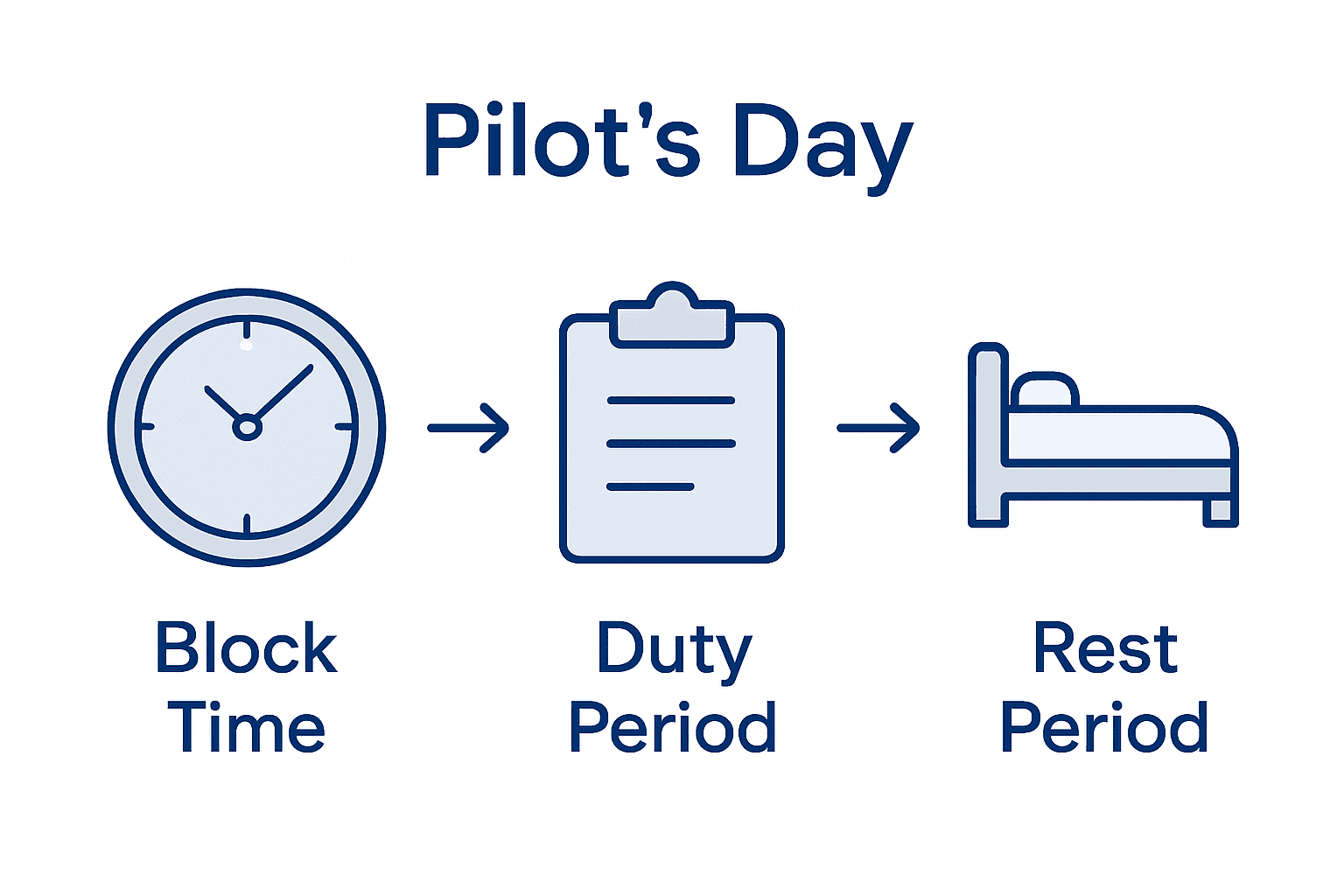
The block time represents the precise duration from when an aircraft begins to move under its own power until it comes to a complete stop at the destination. Duty time encompasses a broader range of professional activities, including pre-flight preparations, actual flying time, post-flight administrative tasks, and potential standby periods. EASA regulations mandate specific maximum limits for these periods, recognising that continuous monitoring and precise calculation are crucial for maintaining pilot alertness and preventing fatigue-related performance degradation.
Understanding the nuanced calculations requires recognising that different scenarios trigger distinct regulatory protocols. For instance, airport standby periods, in-flight rest opportunities, and transition between different types of duties all influence the overall time calculations. The regulations do not simply impose uniform restrictions but provide a sophisticated framework that adapts to the variable nature of aviation operations, considering factors such as time zone changes, consecutive night flights, and individual pilot physiological responses.
Pro Tip: Systematic Tracking: Develop a personalised digital or manual tracking system that meticulously records all duty periods, rest intervals, and block times, ensuring you always remain compliant with EASA’s complex regulatory requirements.
Compliance Obligations and Common Mistakes
Navigating the complex landscape of EASA flight time limitation regulations requires meticulous attention to detail and a comprehensive understanding of potential compliance pitfalls. Controlled rest during standby periods represents a particularly nuanced area where operators frequently misunderstand regulatory requirements, potentially compromising safety protocols.
The most prevalent compliance mistakes often stem from misinterpreting rest and duty period calculations. Fatigue management is not simply about adhering to hour limitations, but understanding the physiological implications of cumulative work periods. Common errors include miscalculating transition times between duties, incorrectly logging standby periods, and failing to account for the subtle differences between different types of rest intervals. Operators must recognise that EASA regulations are designed to prevent gradual performance degradation, which means each recorded time segment carries significant implications for overall aviation safety.
Effective compliance demands a proactive approach that goes beyond mere documentation. Pilots and operators must develop robust systems for tracking and verifying time allocations, recognising that regulatory compliance is a dynamic process requiring continuous monitoring and adaptation. This involves not just recording hours, but understanding the underlying principles of fatigue management, individual physiological variations, and the potential cascading effects of seemingly minor scheduling discrepancies. The regulations are intentionally sophisticated, reflecting the complex nature of human performance in high-stress aviation environments.
To help prevent common compliance mistakes, compare these potential pitfalls and strategies:
| Common Error | Risk to Operations | Effective Prevention Strategy |
|---|---|---|
| Miscalculating transition times | Unintentional regulatory breaches | Use automated tracking tools |
| Inadequate logging of standby periods | Possible overwork or fatigue | Maintain detailed personal logs |
| Failing to factor split/rest intervals | Accumulated sleep deficit | Double-check calculations |
| Ignoring time zone impacts | Disrupted circadian rhythm | Plan schedules with offsets in mind |
Pro Tip: Compliance Vigilance: Implement a double-verification system for all flight and duty time records, cross-referencing personal logs with official documentation to ensure absolute accuracy and regulatory adherence.
Master Flight Time Limitations to Protect Your Wellbeing and Career
Understanding EASA flight time limitations is vital for pilots aiming to ensure both safety and personal wellbeing. This article highlights challenges such as managing complex duty periods, tracking rest requirements, and preventing cumulative fatigue. These issues can affect your performance and long-term career in commercial aviation. With terms like Flight Duty Period, block time, and standby clearly explained, you need specialised knowledge and tools to stay compliant and confident in your professional life.

Take control of your aviation journey by enrolling in the extensive theoretical courses at Academy – VictorOne. Our online EASA-approved training covers all foundational concepts needed to meet regulatory demands and master fatigue management. Study flexibly from anywhere and gain access to expert support tailored for aspiring pilots who want to excel safely. Visit VictorOne now to secure your place and start advancing your career with confidence. Discover how practical understanding of regulations can make you a safer and more effective pilot today.
Frequently Asked Questions
What are flight time limitations set by EASA?
Flight time limitations set by EASA define the maximum hours a pilot can fly and the required rest periods to mitigate fatigue and ensure safety during operations.
How do EASA regulations impact pilot wellbeing?
EASA regulations enhance pilot wellbeing by preventing fatigue through structured duty and rest periods, thus maintaining high safety standards and supporting pilots’ physical and mental health during operations.
What are the key components of EASA flight duty periods?
Key components of EASA flight duty periods include definitions of flight duty period (FDP), standby periods, block time, and duty time, all of which frame pilots’ work schedules and rest requirements.
How can pilots ensure compliance with EASA flight time regulations?
Pilots can ensure compliance by meticulously tracking their duty periods, maintaining detailed logs of flight hours and rest intervals, and staying informed about any updates to EASA regulations.