Most british aviation students are surprised to learn that the requirements for helicopter and aeroplane licences differ in more than just training hours. For anyone planning a career in aviation, choosing the right path shapes not only your education but your job options and income prospects. With over 3,000 new private pilot licences issued yearly in the United Kingdom alone, this guide will highlight what sets helicopter and aeroplane certifications apart so you can make an informed decision.
Table of Contents
- Helicopter And Aeroplane Licences Defined
- Major EASA Licence Differences Explained
- Training Requirements For Each Pathway
- Theory Course Variations And Format
- Career Opportunities And Financial Impact
Key Takeaways
| Point | Details |
|---|---|
| Licensing Variations | Helicopter and aeroplane licences have distinct training hour requirements and privileges, significantly affecting pilot career pathways. |
| Theoretical Foundations | Both licences require comprehensive theoretical knowledge, but the context and practical application differ between rotary and fixed-wing operations. |
| Career Implications | The choice of licence impacts earning potential and job opportunities, with helicopter pilots often specialising in niche fields. |
| Regulatory Framework | EASA guidelines establish essential distinctions between licence types, guiding pilot training and certification across Europe. |
Helicopter and Aeroplane Licences Defined
In the world of professional aviation, understanding the nuanced differences between helicopter and aeroplane licences is crucial for aspiring pilots. Both licence types fall under the European Union Aviation Safety Agency (EASA) regulatory framework, which provides standardised guidelines for pilot certification across European member states.
The core licence categories for rotary and fixed-wing aircraft include the Light Aircraft Pilot Licence (LAPL) and Private Pilot Licence (PPL), each with specific requirements tailored to helicopter and aeroplane operations. EASA regulations outline distinct privileges and limitations for these licences, ensuring pilots meet comprehensive training and experience standards for safe aircraft operation.
Helicopter and aeroplane licences differ significantly in their training pathways, medical requirements, and operational contexts. While both licence types require extensive theoretical knowledge and practical flight experience, helicopter training demands unique skills such as hovering, confined area operations, and more complex three-dimensional manoeuvring. Aeroplane licences, conversely, focus on longer-distance navigation, runway operations, and managing fixed-wing aerodynamic principles. The Easy Access Rules provide detailed frameworks for these distinctions, ensuring pilots receive comprehensive, category-specific training.
Key differences between helicopter and aeroplane licences include:
- Distinct flight hour requirements
- Specific medical certification standards
- Unique theoretical knowledge examinations
- Varied practical skill assessments
- Different aircraft-specific operational limitations
Prospective pilots must carefully consider these nuanced requirements when selecting their preferred aviation pathway, understanding that each licence represents a specialised professional qualification tailored to specific aircraft characteristics and operational environments.
Major EASA Licence Differences Explained
EASA regulations establish critical distinctions between helicopter and aeroplane pilot licences that significantly impact training requirements, operational privileges, and professional pathways. Understanding these nuanced differences is essential for pilots navigating their career development within European aviation standards.
The fundamental variations begin with training hours and theoretical knowledge requirements. EASA licensing guidelines specify that Private Pilot Licences (PPL) for aeroplanes demand approximately 100 theory hours and 45 flight hours, compared to Light Aircraft Pilot Licences (LAPL) which require around 30 theory hours and 30 flight hours. These variations reflect the complexity and skill differentials between rotary-wing and fixed-wing aircraft operations.
Operational privileges represent another crucial distinction between helicopter and aeroplane licences. While both licence categories enable non-commercial flying, the PPL(H) for helicopters provides more extensive privileges, including potential instructor and examiner qualifications. The regulatory framework specifies different cross-country solo flight minimums and experience requirements that reflect the unique challenges of helicopter flight training.
Key comparative aspects of EASA helicopter and aeroplane licences include:
- Distinct minimum flight instruction hours
- Varied theoretical knowledge examination content
- Different medical certification standards
- Unique practical skill assessment criteria
- Specific aircraft-type operational limitations
Prospective pilots must carefully evaluate these regulatory differences, recognising that each licence represents a specialised professional qualification tailored to the distinctive operational characteristics of rotary or fixed-wing aircraft. The choice between helicopter and aeroplane licensing ultimately depends on individual career aspirations, personal aptitudes, and the specific aviation sector one wishes to pursue.
Training Requirements for Each Pathway
Pilot training pathways for helicopters and aeroplanes involve distinct and rigorous requirements that reflect the unique challenges of each aircraft type. EASA licensing guidelines establish comprehensive frameworks defining precise training standards for aspiring pilots seeking Light Aircraft Pilot Licence (LAPL) and Private Pilot Licence (PPL) certifications.
For helicopter licences, the training structure demands meticulous attention to specific flight time allocations. The Part-FCL regulations specify that LAPL(H) requires a minimum of 40 total flight hours, including 20 hours of dual instruction and 10 hours of solo cross-country flying. Private Pilot Licence for Helicopters (PPL(H)) demands more extensive preparation, mandating 45 total flight hours with 25 hours of dual instruction and detailed cross-country experience requirements that test a pilot’s comprehensive skill set.
Aeroplane licensing follows a similar but distinct training pathway, with regulatory frameworks outlining specific training hour breakdowns. LAPL(A) typically requires around 30 flight hours, while PPL(A) necessitates approximately 45 flight instruction hours. These variations reflect the different operational complexities inherent in fixed-wing aircraft operations, ensuring pilots develop robust skills matched to their specific licence category.
Key training differences between helicopter and aeroplane pathways include:
- Varying minimum total flight hour requirements
- Distinct dual instruction hour allocations
- Specific cross-country flight experience mandates
- Unique theoretical knowledge examination content
- Different practical skill assessment criteria
Prospective pilots must carefully evaluate these nuanced training requirements, recognising that each pathway represents a specialised professional development journey. The choice between helicopter and aeroplane licensing ultimately depends on individual career aspirations, personal aptitudes, and the specific aviation sector one wishes to pursue.
Theory Course Variations and Format
Theoretical knowledge represents a critical foundation for both helicopter and aeroplane pilot licensing, with EASA establishing comprehensive standardised requirements that ensure consistent and rigorous educational standards across different aircraft categories. EASA licensing guidelines mandate approximately 100 theory hours of instruction for aspiring pilots, covering essential subjects that remain consistent across helicopter and fixed-wing training pathways.
The theoretical curriculum encompasses crucial domains including air law, navigation, meteorology, aircraft performance, human performance, and operational procedures. Each licence category requires candidates to demonstrate comprehensive understanding through structured examinations that assess theoretical competence across these critical knowledge areas. Regulatory frameworks specify detailed qualification prerequisites, including minimum age requirements and type-rating pre-conditions for both Approved Training Organisations (ATOs) and Declared Training Organisations (DTOs).
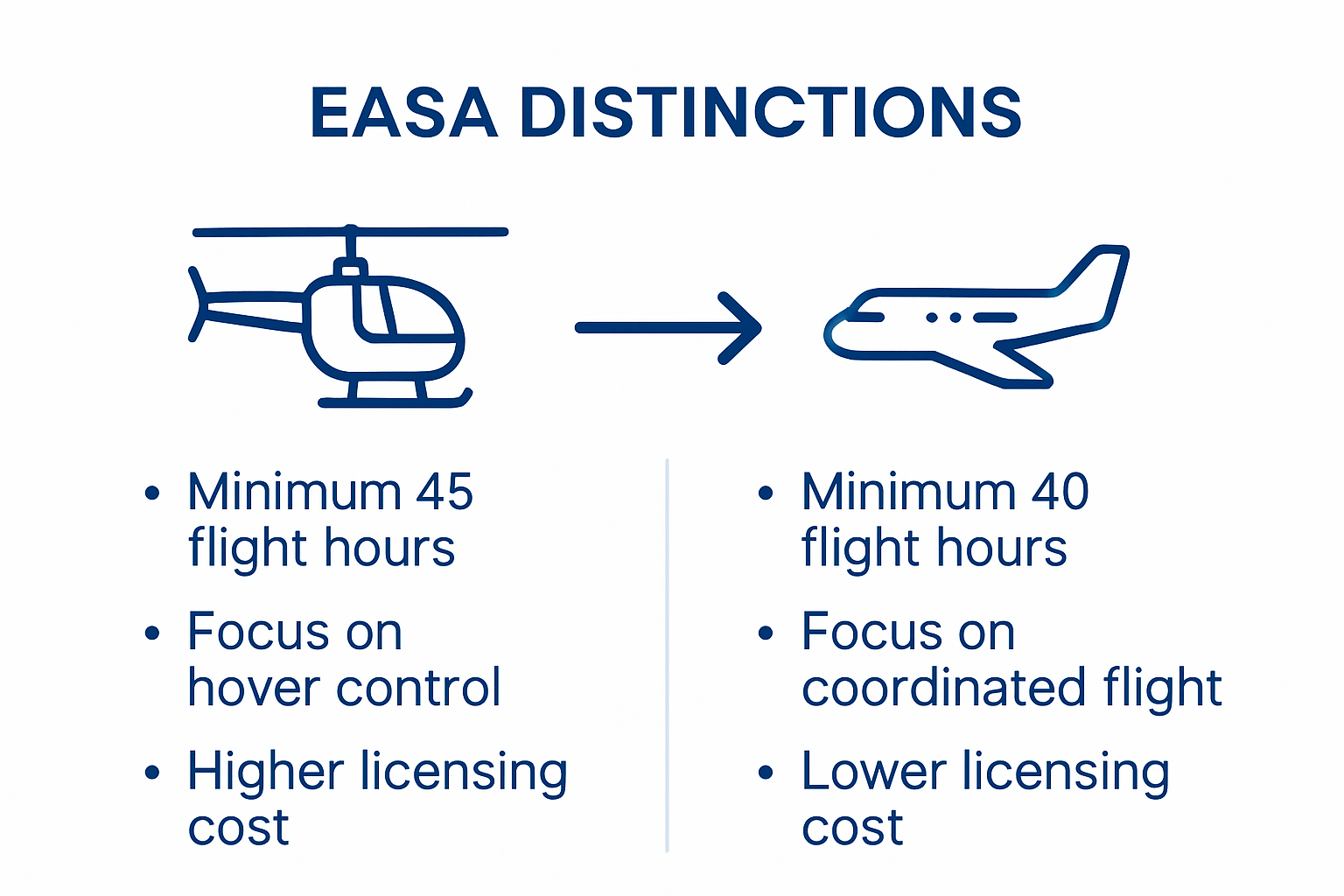
Significant variations emerge in the practical application of theoretical knowledge between helicopter and aeroplane licensing. While the core subject matter remains consistent, the contextual interpretation and practical implementation differ substantially. Helicopter theory courses emphasise three-dimensional manoeuvring, hover techniques, and confined area operations, whereas aeroplane theory focuses more on extended navigation, runway procedures, and complex aerodynamic principles. This nuanced approach ensures that theoretical training directly supports the unique operational characteristics of each aircraft type.
Key differences in theoretical training include:
- Identical core knowledge domains across licence categories
- Specific contextual interpretations for rotary and fixed-wing aircraft
- Varied practical application of theoretical concepts
- Consistent examination standards
- Tailored instructional approaches reflecting aircraft-specific challenges
Prospective pilots must recognise that theoretical training represents more than mere academic exercise. It forms the intellectual foundation upon which practical flying skills are constructed, demanding serious commitment, analytical thinking, and a profound understanding of aviation’s complex scientific and regulatory landscape.
Career Opportunities and Financial Impact
The choice between helicopter and aeroplane pilot licences carries significant implications for professional development and financial potential within the aviation industry. EASA licensing guidelines highlight nuanced pathways that distinguish between different licence categories, particularly regarding career progression and earning opportunities.
Private Pilot Licence (PPL) holders, especially those with additional instructor or examiner privileges, unlock substantially broader career prospects compared to Light Aircraft Pilot Licence (LAPL) holders. The regulatory frameworks explicitly outline potential financial benefits for pilots who achieve advanced certification, enabling remuneration through flight instruction, skill testing, and proficiency checks. This creates a compelling incentive for pilots to pursue more comprehensive licensing pathways.
Career trajectories for helicopter and aeroplane licence holders diverge significantly across various aviation sectors. Helicopter pilots frequently find opportunities in specialised fields such as emergency medical services, search and rescue, offshore operations, and aerial surveying. Aeroplane licence holders, conversely, typically pursue commercial aviation routes, including passenger transport, cargo operations, and agricultural aviation. The financial implications of these pathways vary considerably, with helicopter specialists often commanding premium rates for niche operational skills.
Key career and financial considerations include:
- Varied earning potential across different licence categories
- Distinct opportunities in specialised aviation sectors
- Potential for instructor and examiner endorsements
- Flexibility in professional development pathways
- Long-term career progression strategies
Prospective pilots must carefully evaluate their personal aspirations, understanding that the initial investment in training represents a gateway to diverse and potentially lucrative professional opportunities. The choice between helicopter and aeroplane licensing is not merely a technical decision, but a strategic career investment with profound long-term implications.
Master the Differences Between Helicopter and Aeroplane Licences with VictorOne
Navigating the distinct requirements and career pathways for helicopter versus aeroplane licences can be overwhelming. From understanding unique training hour mandates to mastering specific theoretical knowledge and practical skills, aspiring pilots face many challenges highlighted in the latest EASA regulations. If you aim to confidently progress in your aviation career with expert guidance, VictorOne’s Academy – VictorOne offers fully online, EASA-approved theory courses tailored to your chosen licensing path.
Start your journey today by accessing comprehensive digital learning materials, interactive question banks, and professional online support that adapt to your personal schedule. Whether you are pursuing helicopter or fixed-wing certification, VictorOne provides the essential tools for success. Explore the specialised courses, register for exams, and advance your career with proven resources at VictorOne. Embrace the opportunity to learn flexibly and effectively right now.
Frequently Asked Questions
What are the main differences between helicopter and aeroplane licences?
The main differences include training pathways, flight hour requirements, medical certification standards, theoretical knowledge examinations, practical skill assessments, and operational limitations for each aircraft type.
How many flight hours are required for a Light Aircraft Pilot Licence (LAPL) compared to a Private Pilot Licence (PPL)?
A LAPL for helicopters typically requires a minimum of 40 flight hours, while a PPL for helicopters requires around 45 flight hours. In contrast, an LAPL for aeroplanes requires about 30 flight hours, and a PPL for aeroplanes also requires approximately 45 flight hours.
What theoretical knowledge is covered in helicopter and aeroplane training?
Both helicopter and aeroplane training cover essential subjects such as air law, navigation, meteorology, and human performance. However, helicopter courses focus more on hovering and three-dimensional manoeuvring, while aeroplane courses emphasise extended navigation and runway procedures.
What career opportunities are available for helicopter pilots compared to aeroplane pilots?
Helicopter pilots often find roles in specialised fields like emergency medical services and search and rescue, whereas aeroplane pilots typically pursue commercial aviation, including passenger transport and cargo operations. The earning potential in these fields can vary significantly based on the niche skills required.
Recommended
- Understanding the Helicopter Pilot Licence: What You Need to Know – VictorOne
- How to Earn Your Helicopter Pilot Certificate Easily – VictorOne
- How to Become a Helicopter Pilot: Step-by-Step Training Guide – VictorOne
- Complete Guide to Pilot Licence Requirements – VictorOne
- Civil vs Structural Plans: Key Differences Explained – FloridaLicensedEngineers.com